
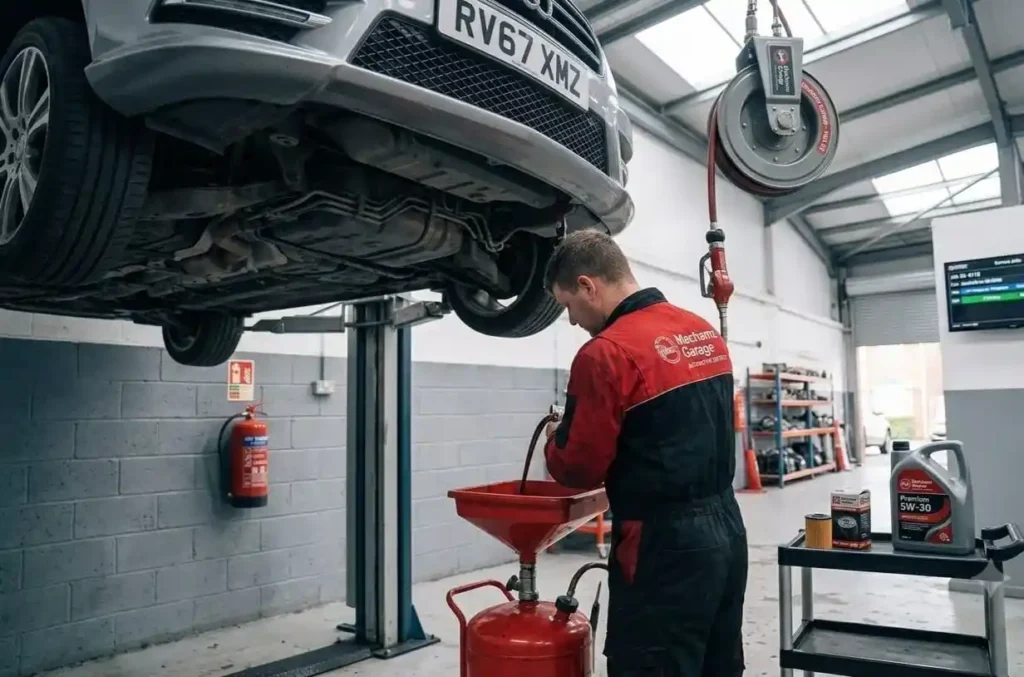
It’s one of the cheapest, simplest bits of car maintenance there is — and also one of the most skipped. Engine oil doesn’t fail dramatically or announce itself with a warning light the moment it’s due. It quietly degrades in the background, which is exactly why so many drivers put off their oil change far longer than they should, often without realising the damage building up underneath.
In this guide, the team at Mechamz Garage in Halesowen explains exactly why engine oil matters so much, how often you should really be your Engine oil change it, the warning signs of neglected oil, and what to expect from a proper oil change — whether you’re due a routine service or trying to work out why your engine’s started sounding a bit different.
Why Engine Oil Matters More Than Most Drivers Realise
Engine oil does far more than just “lubricate.” It reduces friction between fast-moving metal components, helps carry heat away from the engine, cleans away small particles and carbon deposits, and forms a protective film that stops metal-on-metal contact inside your engine every single time you drive. Without it, or with oil that’s broken down and lost its properties, your engine is essentially running dry in places it was never designed to.
As RAC Drive explains, oil should be changed according to your vehicle manufacturer’s recommendations — typically every 5,000 to 7,500 miles, depending on the oil type and your driving conditions, with your owner’s manual containing the exact figure for your specific car. Beyond mileage, most manufacturers also set a time-based limit, since oil degrades even in cars that aren’t driven much.
How Often Should You Really Change Your Engine Oil?
There’s no single number that applies to every car, but here’s a general guide:
- Conventional (mineral) oil — typically every 3,000–5,000 miles
- Semi-synthetic oil — typically every 5,000–7,000 miles
- Full synthetic oil — often good for 7,000–10,000+ miles, depending on the manufacturer’s specification
- Time-based limit — most manufacturers recommend changing oil at least once every 12 months, even if you haven’t covered many miles, since oil degrades with age and moisture, not just use
- Modern cars with service indicators — many newer vehicles will flag when an oil change is due based on driving conditions rather than a fixed interval, so it’s worth checking your dashboard display alongside your handbook
Driving style matters too. Frequent short journeys, stop-start city traffic (common across Halesowen and the Black Country), towing, or regular cold starts all cause oil to degrade faster than steady motorway driving, even within the same mileage interval.
Warning Signs You Need Engine Oil change
1. Dark, Gritty, or Thick Oil on the Dipstick
Fresh oil is usually amber or golden and flows freely. As it ages, it darkens, thickens, and can become gritty with contaminants. If your dipstick shows dark, sludgy oil, it’s overdue.
2. Engine Running Louder or Noisier Than Usual
Oil creates a protective film between moving parts. As it degrades, that protection weakens, and you may start to notice increased engine noise, particularly on start-up. If you’ve noticed unusual noises recently, it’s worth reading our hidden car issues guide, since engine sounds are often dismissed until they become a much bigger problem.
3. Oil Warning Light on the Dashboard
This can mean low oil level or low oil pressure, and shouldn’t be ignored. Continuing to drive with this light on risks serious, potentially irreversible engine damage.
4. Burning Smell From the Engine Bay
A burning oil smell can indicate a leak onto a hot engine component, or oil that’s degraded and struggling to properly lubricate and cool the engine as it should.
5. Exhaust Smoke
Blue-tinged exhaust smoke can be a sign of oil burning within the combustion chamber, sometimes linked to worn engine components that neglected oil changes have contributed to over time.
6. Increased Engine Temperature
Because oil also helps carry heat away from the engine, degraded or low oil can contribute to your engine running hotter than it should. If you’ve noticed your temperature gauge creeping up, our guide on head gasket failure symptoms and causes covers how prolonged overheating can eventually cause much more serious damage.
7. It’s Simply Been Longer Than Your Service Interval
Sometimes there’s no dramatic symptom at all — it’s simply been longer than the recommended mileage or time interval since your last change. This is the most common reason we see engines showing early wear that could easily have been avoided.
What Happens If You Neglect Engine Oil Changes?
- Increased engine wear — metal components grinding against each other without proper lubrication wears them down far faster than normal
- Sludge build-up — old, degraded oil can form sludge that clogs oil passages, restricting flow to critical components
- Reduced fuel efficiency — a poorly lubricated engine has to work harder, using more fuel to do the same job
- Overheating — oil plays a role in heat management, and neglected oil can contribute to a hotter-running engine over time
- Engine seizure — in the most extreme cases, severely neglected oil can lead to catastrophic engine failure, often resulting in a full engine replacement rather than a repair
This is why an oil change is genuinely one of the highest-value maintenance jobs you can do — a relatively small, affordable job that protects one of the most expensive components in your entire vehicle. If neglect has already led to wider issues, our gearbox repair and complete car repair guide for Halesowen drivers pages cover more of what a bigger repair job can involve.
Is It Safe to Keep Driving on Overdue Oil?
A short delay of a few hundred miles past your service interval generally won’t cause immediate harm, but continuing to drive for a long period on old, degraded oil steadily increases wear on your engine — often invisibly, until a bigger problem surfaces. If your oil warning light is on, or you’re noticing any of the symptoms above, it’s best to book your car in rather than keep pushing the interval.
You can book an appointment with Mechamz Garage here or call us on 07417 379127. We also offer a dedicated engine oil change service in Smethwick alongside our Halesowen workshop.
What Happens During a Professional Oil Change at Mechamz Garage
- Draining the old oil completely from the engine, along with removing and replacing the oil filter
- Visual inspection of the drained oil — colour, consistency, and any contamination can tell us a lot about engine condition
- Checking for leaks around the sump, filter housing, and gaskets while the underside is accessible
- Refilling with the correct oil grade and specification for your specific engine, exactly as set out by the manufacturer
- Resetting the service interval indicator on vehicles fitted with one, so your dashboard accurately reflects when the next change is due
- Wider quick checks — as part of most oil changes, we also check coolant, brake fluid, and other key fluid levels while we’re under the bonnet, similar to what’s covered in our complete vehicle health check
Typical Engine Oil Change Costs
Costs vary depending on your vehicle’s engine size, the type of oil required (conventional, semi-synthetic, or full synthetic), and filter type — but as a general guide:
- Conventional oil changes are typically the most affordable option
- Full synthetic oil costs more upfront but often lasts significantly longer between changes
- Larger or performance engines generally require more oil and sometimes specific specifications, affecting overall cost
- Combining an oil change with a wider service — such as alongside a diagnostic check or MOT test — is often more cost-effective than booking separate visits
We always provide a clear, upfront quote using the correct oil specification for your vehicle, so you know exactly what you’re paying for and why.
Tips to Keep Your Engine Oil Working Properly Between Changes
- Check your oil level monthly using the dipstick, ideally when the engine is cold
- Top up promptly if the level is low, using the correct oil type for your vehicle
- Don’t ignore the oil warning light — pull over safely and get it checked as soon as possible
- Stick to time-based intervals, not just mileage, particularly if you mostly do short journeys
- Use the manufacturer-specified oil grade, since using the wrong specification can affect performance and engine protection
- Book seasonal checks, particularly ahead of long journeys, as covered in our seasonal car care guide
Why Halesowen Drivers Trust Mechamz Garage for Servicing & Oil Changes
- Correct oil specification for every vehicle, not a one-size-fits-all approach
- Transparent, honest pricing with a clear quote before any work begins
- Experienced technicians who check for wider issues while carrying out routine maintenance, not just the job in front of them
- Full workshop facilities, from clutch replacement and exhaust replacement to suspension work and full MOT testing near Dudley
Read more about our approach on our why choosing the right auto garage in Halesowen matters page, or browse the ultimate guide for Halesowen drivers for more on keeping your car reliable year-round.
Areas We Cover
Mechamz Garage is based in Halesowen, and we regularly carry out oil changes and servicing for drivers across the wider Black Country, Birmingham, and West Midlands region. Our dedicated local service pages include:
Black Country & Dudley Borough:
Halesowen, Cradley Heath, Dudley, Netherton, Sedgley, Gornal, Coseley, Blackheath, Lapal, Romsley, Belbroughton, Clent, Hagley
Sandwell: Oldbury, Smethwick, West Bromwich, Rowley Regis, Tipton
Wolverhampton & Staffordshire:
Wolverhampton, Bilston, Wednesfield, Willenhall, Walsall, Aldridge, Cannock, Stafford, Lichfield, Tamworth
Stourbridge & Worcestershire:
Stourbridge, Kingswinford, Bromsgrove, Redditch, Kidderminster, Worcester, Droitwich Spa, Bewdley
Birmingham:
Birmingham City Centre, Edgbaston, Harborne, Selly Oak, Bournville, Northfield, Great Barr, Sutton Coldfield, Erdington, Moseley, Kings Heath, Shirley, Solihull, Knowle
Warwickshire & Beyond:
Coventry, Kenilworth, Royal Leamington Spa, Warwick, Stratford-upon-Avon, Nuneaton, Rugby
Shropshire & Herefordshire:
Shrewsbury, Telford, Bridgnorth, Hereford, Ross-on-Wye, Ledbury
We also offer dedicated air conditioning repair coverage across most of these same towns, plus mobile mechanic services around Cradley Heath for certain jobs. Not sure if you’re in our catchment? Check our auto garage near me in Halesowen page or give us a call.
Frequently Asked Questions
How do I check my engine oil level at home?
Park on level ground with the engine cold, locate the dipstick, wipe it clean, reinsert it fully, then pull it out again to check the level against the minimum and maximum markers. The DVSA’s official vehicle safety guidance covers this as part of the standard “show me, tell me” checks used in driving tests.
Can I use any oil in my car?
No. Always use the oil grade and specification recommended by your vehicle manufacturer, found in your owner’s manual. Using the wrong specification can affect engine protection and, in some cases, invalidate warranty cover.
What’s the difference between synthetic and conventional oil?
Full synthetic oil is engineered for more consistent performance across a wider temperature range and generally lasts longer between changes than conventional (mineral) oil, though it typically costs more per change.
Is it bad to change oil too early?
Not really — changing oil ahead of schedule causes no harm, whereas leaving it too long steadily increases engine wear. If in doubt, erring on the side of an earlier change is the safer choice.
What does it mean if my oil warning light comes on while driving?
This usually indicates low oil level or low oil pressure and should be treated seriously. Pull over safely as soon as possible and avoid continuing to drive, since doing so risks serious engine damage.
How long does an oil change take?
A standard oil change is usually one of the quicker jobs we carry out, often completed within an hour, though this can vary slightly depending on the vehicle and whether any additional checks are needed.
Final Thoughts
An engine oil change is one of the smallest, most affordable pieces of maintenance you can do for your car — and also one of the most consequential if it’s neglected. Sticking to your manufacturer’s recommended interval, paying attention to the early warning signs, and not waiting for a dashboard light to force the issue will do more for your engine’s long-term health than almost anything else.
The team at Mechamz Garage in Halesowen offers straightforward, correctly specified oil changes and honest advice on what your car actually needs — no upselling, just proper maintenance done right.
📍 Mechamz Garage — Unit 13, Western Business Park, Coombs Rd, Halesowen B62 8AE 📞 Call or WhatsApp: 07417 379127 ✉️ Email: info@mechamzgarage.co.uk 🕓 Opening Hours: Mon–Wed 7AM–4PM | Thu–Fri 7AM–3PM | Sun 8AM–2PM
👉 Book your engine oil change online or explore our full range of car repair and maintenance services in Halesowen.
